Education After The Pandemic

One of the many troubling issues impacted by the pandemic is the future of higher education. Virtually every college has either shut down or provided instruction online during the last few months of the school year. Will colleges provide a different kind of educational experience moving forward? Seems to me the answer is a resounding probably.

The state of college education was not perfect before the virus ruined our lives. Millions of past and current students incurred extraordinarily large student loans. Many politicians are proposing that this debt be forgiven or restructured, yet another prospective entitlement that the US government may not be able to afford.

The classes some students take have not been helpful in finding rewarding employment after graduation. Arts and letters courses do not provide the academic knowledge most corporations are looking for in new recruits. The result has been over-qualified graduates in low paying jobs.

So, let’s agree that the educational system was ripe for change. School administrators were considering a plethora of significant modifications even before the virus reared its ugly head.

When you think about the settings of most large campuses, you probably have a vision of an idyllic place of learning with scores of students mingling, studying and smiling.

Could there be a better place for a contagious disease to spread than colleges? Dorm rooms are mostly unkempt, multiple people reside in one suite, classrooms are crowded, the library is jammed each evening and the athletic facilities are places where viruses and bacteria can easily multiply. What about the social scene, where everyone is crowed into bars and party spaces?

The question is can students affectively learn remotely? This is a subject that has not been fully examined until now. Many elementary schools, high schools and colleges have taken to teaching via the Internet recently. It seems to work fine, especially for children that don’t need extra supervision. The young ones, maybe not so good.

Of course, the pandemic’s schooling system has a gigantic void- socialization. Being with others makes children more in tune with society where interfacing with others is so important, at least up to now. Is giving up the social part of education worth it if hundreds, thousands or millions of people can avoid getting sick and possibly die?

The older students are protesting the loss of social interaction in this new reality. In college and grad schools, in particular, students are crying out that their education is being diminished because they aren’t able to have face to face conversations with others, to build long-term relationships.

How will schools react? Will they decrease tuition? Room and board expenses would decrease if students studied from home. So, the total cost of attending college could go down materially, a good thing (for students, not for schools). Will foreign students continue to study in the US? This is important to colleges for several reasons. One is that these students pay full tuition and generally are not subsidized, so their tuition payments are important to schools. Secondly, not having international contribution on campus would be unfortunate for diversity reasons.

And now, it’s time for my observations and opinions. Notwithstanding the student debt problem, and students taking irrelevant classes that don’t help them at work, I think our educational system is excellent. There are problems affiliated with admission policies, income inequality and diversity. But, if you want your children to be educated to do something wonderful for their families and themselves, the US educational system is the best place in the world to learn. I would be happy if schools went back to the original structure after the pandemic is defeated.

On the other side, student debt has become a multi-trillion-dollar albatross for many young people and their parents. There are many things we can learn from the pandemic educational experience that could allay this growing problem. For those that don’t need a social experience, an online education should be far less expensive and be offered by the most prestigious schools.

Colleges should include a social experience, but the main objective is to be educated. I hope we make available some of the new techniques that have been developed to fight against the virus. And perhaps some children can do the requisite work in less time (three years instead of four) if they give up some of the un-productive social activities.
Pandemic vs. Economic Armageddon

Countries, corporations and even small businesses are in a very tenuous position because of the pandemic. It’s a fact that returning to normalcy is the only way to avoid financial Armageddon. Yet, the risk of higher incidences of coronavirus that will likely result from normalcy could be catastrophic for those leaders and businessmen who move forward with this strategy.

Let’s discuss the two options available to leaders in a general way.

Getting the economy back on track is clearly one of the highest priorities for everyone. Millions of people in the US are receiving unemployment support and other benefits, but there is no way these entitlements can last too much longer.

It’s important to appreciate that the country is already deeply in debt. Our leaders decided to give a boost to companies in dire straits and to individuals that were furloughed or summarily fired. It was the right thing to do, but it added several trillion dollars to our already bulging national deficit.

Basic economic theory tells us that printing too much money can weaken a currency. Excessive spending may cause a devaluation of the dollar and fuel hyper-inflation. Exacerbating the situation would be the short-term impact of declining GNP. Ironically, less spending by consumers and businesses could possibly bring on a serious recession, or a depression that could rival the one in the early 1900s.

If the economy does not improve soon, it’s likely that millions of smaller businesses will be closed permanently. Consider the plethora of small mom and pop businesses that are domiciled in our cities. No one bankruptcy is significant, but hundreds of thousands of them would be unthinkable. These businesses will fail and never open again, if Americans are forced to continue to eschew them as part of an effort to fight the virus. Similarly, many larger businesses could face financial demise if workers are not allowed to return in the face of federal, state and local governments edicts.

A decision to stand tall and confront the coronavirus by continuing with isolation and distancing may be beneficial in the battle to rid us of the disease, but it will ultimately tank the economy. And with this contingency, citizens will suffer in unimaginable ways.

The other alternative is for governmental leaders to encourage people to reopen their businesses. The stock market is waiting for this existential moment, but the euphoria might be short lived. There is evidence worldwide that those countries who return to normalcy experience a ramp up of new cases of the virus. Given that therapies and more importantly vaccines have not been approved, resurgence could affect millions of people health-wise.

So, a decision to move forward with the economy is equally dangerous for our leaders. A better economy with a million more cases of the virus may or may not be a good trade-off. A decision may very well be impacted by projected new deaths.

Government officials in the US and around the world are in a precarious situation. What are the trade-offs of the two alternatives available? If leaders guess wrong and a lot of people become sick and die, they will be ostracized? If they are correct, they will be heroes and reap the political benefits.

The best strategy for the US and any large corporation may be to wait a short period of time until the results of others can be analyzed.

Note: This last analysis also holds true for CEOs of big companies who must decide when to ask their employees to return to work. Waiting to see how other similar companies fair maybe the wisest thing to do.


The Subway Conundrum

New York City has become an enigma that is perplexing its leaders as they plan for a return to normalcy. One of the big questions is how will the governor and mayor get several million people to work every day without the obvious dangers affiliated to public transportation?

A subway car is a petri dish for the coronavirus. It’s underground. It will be hot and humid in the subways in the spring and summer. Commuters are stacked into cars like sardines. The trains are filthy for the most part. Cleaning them is a logistical nightmare and really too costly for the Metropolitan Transit Authority to do effectively.

The CEOs of all the major companies in New York City are scratching their heads trying to figure out how to get their employees into work without endangering them. The threat relates to distancing and uncleanliness. The honest answer is, it may be impossible to create a safe environment for the thousands of strap holders that depend upon subways.

If services are rearranged, limiting the number of people in each car, increasing travel at off hours, closing the subways from 12:00 a.m. to 5:00 a.m., the situation would be better, but can the MTA manage the process.

Most business activity occurs between 8:00 AM and 6:00 PM each day, when workers are required to be present on the job. Banks aren’t going to open in the evening. Restaurants aren’t going to serve food all night long. The New York Stock Exchange and NASDAQ are not going to change their hours of operation. Motor Vehicles isn’t going to accommodate drivers in the middle of the night. And what about sporting events, nightclubs and Broadway?

Many children also commute to school on subways. Their hours are not really flexible. And all those office buildings that accommodate hundreds of thousands of personnel are going to find it difficult to manage the flow of employees during high traffic times on elevators. Distancing will be virtually impossible.

The first thing we need to do is decrease the number of new cases of people suffering from the virus. While doing so, somebody better be trying to figure out how to move several million people into and out of Manhattan and surrounding boroughs safely.

Health Concerns vs. Economic Disaster

The battle between supporters of these two strategies will have a profound effect on the outcome of the presidential election.

How long can the pandemic last without permanently destroying America? It’s time to ask the tough questions as our leaders decide when and how to restart the economy.

It’s not difficult to forecast what will happen to the US economically if Americans don’t go back to work in the near future. It might be the worst of all contingencies, a full-fledged depression.  More and more people will be unemployed and eventually be unable to care for their families. Liberals don’t appreciate that the US’s ability to print more money and give it to those in need is reaching the breaking point. The viability of the American dollar could be at stake.

Aside from out of control unemployment, our leaders may have to deal with many other possible implications of keeping people at home. How long will Americans continue to abide by orders to stay inside and distance from others? Already young people are defying warnings from governors and mayors. Orthodox Jews ignored an order from Mayor de Blasio in New York City to not conduct a large celebration of a deceased rabbi’s life. Scores of celebrants interfaced in close quarters and took a chance they would spread the virus.

And how long will parents be able to restrain their children? Schools will be ending soon, so no longer will the kids be required to sit through online classes. Cabin fever is setting in. Humans are social animals. It will be impossible for officials to keep control and virtually incarcerate citizens for much longer.

Literally, the existence of retailers, restaurants and sporting teams is in the hands of the federal and local governments throughout the country.

By forbidding individuals to shop at retailers, officials are dooming a whole industry, which in turn effects many workers, including the sales chain and distribution companies that service the stores.

Restaurants are feeling the pain. Given that many are small businesses with limited resources, it will not take an extended period of closure to put these people out of business permanently. It has already happened for many mom and pop eateries that feed many Americans.

Sporting events are really important to the people who buy tickets, the cities that house them and those that watch events on TV. And what about the companies and workers that televise sporting events? Millions, which will soon turn into billions, have been lost.

What is the alternative? Officials could open the economy and tell everyone to return to normalcy. The big question is: will Americans send their children to schools, go to restaurants and attend sporting events if the authorities say it is OK do so? And if they respond positively, how will the virus react?

The final issue is the real kicker. Can this pandemic become more virulent than it already is? Will it become more aggressive and kill substantially more people, if isolation and distancing ceases? Is there another outbreak on the horizon, if America gives up its safeguards? Can the virus actually threaten the existence of mankind?

Frankly, the last question probably far-fetched. The disease is a killer, but most people survive it. The data has been slow to come to Americans, but it indicates that mostly older people with pre-existing health issues are the virus’ target. The US has had about 60,000 deaths to date, among 340 million citizens. It seems unlikely that coronavirus is an existential threat to the human race. But, left unchecked a lot more people will die prematurely.

So, our leaders must decide whether to give us an all clear sign, to save our economy. If they do so, and the virus fades away, the decision makers will be heroes. If the opposite occurs, and body bag start piling up, the decision makers will be scorned.

The Good, The Bad And The Ugly

At the moment, Americans are trying to deal with a pandemic that purportedly has the potential to kill millions of people. Death from disease has always been lamented by Americans. Life is not cheap in this country. So, the response to this situation has expectedly overwhelmed our lives for a few months, with much more to come.

I thought it would be worthwhile to discuss what America has done well and not so well in the face of a killer virus. Let me begin with non-medical issues.

Do you appreciate that world leaders have virtually shut down the entire global business community on very short notice? The theory is that everyone should stay home, isolate and distance themselves from others. The devastation that this self-imposed economic paralysis could have on the world economy is something that we should all be very concerned with. But, the effort to keep people from interfacing with each other at work, in school, at play and in familial settings has been astounding. The results are promising.

In a related regard, a great deal of business is still being done over the Internet. Americans can buy food and supplies (most importantly toilet paper) online. And although our access to food is somewhat limited, it’s still possible to find it, even from restaurants on a take-out basis.

Many companies are concluding that it may not be necessary for workers to congregate at their facilities. Work can often be done with a phone and a computer remotely. It will be interesting to see whether the trillions of dollars of real estate owned by corporations to provide services will be divested in the future in favor of a stay at home strategy.

And just as mind-blowing is that every elementary school, high school, college and graduate school is conducting classes from afar. The Internet has enabled teachers to communicate with students that are safely at home. This is a great development, but also, it has been heaven-sent for parents who are trying to keep their children busy.  Just imagine what homes would be like if the kids did not need to spend a few hours each day doing schoolwork.

Changing direction, I want to give another shout-out to our first responders, doctors nurses, soldiers and everyone that has given money and time (and risked their lives) to help those who have been crippled by this menace. As far as I can remember, first responders have always stepped up and did their jobs at great peril. They deserve our eternal thanks for once again helping us survive in a dire situation.

And finally, there are those in the medical profession who are striving to develop treatments and vaccines and manage the process of keeping Americans healthy. Limiting their advice to staying home, washing hands regularly, distancing, and not touching one’s face has been brilliant.

Keep in mind that medical researchers were surprised by this new disease and neither the world nor the US knew exactly how to respond at first. Doctors had to retool, study the disease and figure out how to treat those who became sick. You can’t effectively combat an epidemic much less a pandemic without data. In just a few short weeks, data amassed has enabled these people to make wise, conservative recommendations to our leaders.

Regarding leadership in America, there are many unfortunate criticisms that must be noted. First and foremost, our leaders in previous catastrophes have performed far better than our current president, congress, governors, mayors, and local organizers. When you think about Lincoln, F.D.R., John Kennedy and even George Bush you can appreciate the importance of leadership during difficult moments. Politicians all want to be great and have their own chapter in the history books.  The only thing that will be read 100 years from now is that our leaders were too political and more concerned about their own reputation than saving America.

Getting Back To Normal

Now that our leaders have completely shut down the country, we need to start thinking about getting ourselves back to some representation of normality, socially and economically. The big risk is a recurrence of the pandemic and/or infections infiltrating the US from foreign countries.

The data being received about the danger of the virus has been incomplete and tardy. The president, governors and mayors are saying they want to restart the economy, but do the experts have what they need to help our leaders make good decision. What does it mean to restart the economy? To a great extent Americans must end their isolation and begin to interact with family, fellow workers, people in stores and restaurants, at sporting events, etc. Exacerbating the situation is that some data that would be useful to the experts and to all Americans has not been showcased. See the other blog I posted today for an example of this unfortunate phenomenon.

This is a risky proposition. We’ve been told that social distancing, isolation and good sanitary habits are the only way to defeat the coronavirus. And now we will be asked to re-congregate with other Americans even though some may be infected with the virus.

The other side of the coin is equally disconcerting. If we delay the process of revving up our economy, which would entail Americans being close to other Americans, people will likely starve, some will lose homes and some will become destitute. The risks affiliated with not being social as we were before all this craziness began is as great as the perils associated with remaining dormant economically in an effort to fight the disease.

To be more specific, unemployment is supposedly going to reach double digit figures. Every day more people are being furloughed, mortgages are not being paid, individuals have less and less money to buy food and so on. The government cannot provide for a hundred million people without sustaining a shortage of funds for other necessary services.

So, as I see it, isolation must end soon, but how will mothers react to sending their children to school? How effective will we respond at work if we are frightened that an officemate might infect us with the virus? Would we even consider going to a restaurant with friends and family like we did a few months ago? And what about baseball games, concerts and ballet? No, Americans are going to tread lightly, and all these events where people congregate will suffer for many more months to come regardless of urgings from our leaders.

Getting back to work will be a colossal undertaking. Employees will be concerned with their safety, while employers won’t want to endanger those that work for them. We must be diligent and patient about getting back to the norm, or it all could spin out of control once again.


Are Americans Receiving An Accurate Perspective Of COVID-19?

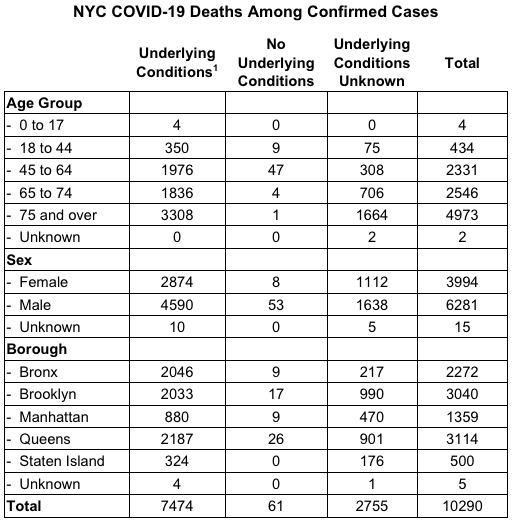
I happen to come upon this chart created by the New York City Department of Health that shows Deaths Among Confirmed Cases of the virus through late April.
There were 10,290 total deaths in NYC attributed to the disease. 7,474 were accompanied by underlying conditions that are delineated below. 61 deaths had no underlying conditions. 2,755 may or may not have had underlying conditions.
If you are a female under the age of 18, the statistics show that you have a 4/10,290 (.8%) chance of dying from COVID-19, even including deaths in the age group that have unknown underlying conditions (there were 0). If you are over 75, you have a  4973/10290 (48%) chance of dying of the virus (including unknown underlying condition deaths).  This is based up stats accumulated to this date and could vary prospectively.
To conclude, the chances of dying from COVID-19 are slim until you reach the age of 45, and even then they are low if you don’t count deaths with unknown underlying conditions.
Wouldn’t it make sense for this information to be showcased widely. Consider decisions about youngsters returning to classes. There is practically no chance of a child being infected and dying from the virus. Of course, falling ill and infecting adults needs to be taken into consideration before any action is taken to open schools.
The point of this blog is that perhaps the panic button was premature and the return to normalcy, if we protect the aged and infirm, can be expedited. I will leave that ultimate decision to the experts. I just hope they are receiving the data needed to make wise decisions. The general population is certainly not being informed by anything but horror stories caused by the disease. I wonder if reporting is politically motivated.
Demographics of New York City COVID Deaths
Each day the New York City Department of Health releases demographic data on COVID-19 deaths. Overwhelmingly, those who die of COVID are aged 65+ and/or those with pre-existing health conditions, which the DOH defines as: “Diabetes, Lung Disease, Cancer, Immunodeficiency, Heart Disease, Hypertension, Asthma, Kidney Disease, and GI/Liver Disease.” Note: these demographics include “confirmed” COVID cases only, and exclude “probable” deaths.

?Unanswered Questions?

As I pass the hours of the day waiting for the end of the pandemic and escape from my self inflicted prison, the only really good news is that our first responders, doctors, nurses and research personnel are finally getting credit for all they are doing to save others. It’s about time that these brave souls were cited for their dedication, empathy and determination.

Beyond this, there are more questions every day. Our leaders and others around the world are playing politics with the virus epidemic. How low can you go? Why isn’t saving lives and ending this menace the first priority of Trump, our Congress, Xi, Putin and all the European heads of state? What the hell is so important about taking credit and passing blame? The renown doctors and scientists must worry about offending two-bit politicians, presidents and despots every time they make a discovery. Negative reports are taboo in this day and age.

Every American I speak with wants answers to the important questions. Like:

How many Americans have contracted the virus?

How many Americans are infected without symptoms?

Can asymptomatic individuals with the disease pass it on to others?

How many Americans have antibodies from a bout with the coronavirus?

Do the antibodies prevent these people from contracting the disease a second time?

Can a person who had the virus and has antibodies infect others?

How long do antibodies last? If it’s a long period of time, and many people have antibodies, the risk of another outbreak should be less. Is this correct?

How many people have died from the virus? This is important if we are ever going to know when the slope of the infection is going down. We need the facts about every death, including the sex, age, location and general health of the deceased, if we if we if we ever will be ever will be able to combat the disease.

Where do we stand with vaccines and other treatments?

Are there enough hospital beds and related equipment available to care for those who are seriously ill?

Instead of worrying about how Trump will respond to a new update, advisors and doctors should focus more on developing treatment and a vaccine. And very importantly we should get answers to the damn questions mentioned above.

Here in Florida, the Mayor of Miami is taking a bold step to put his constituents on the road back to normalcy. He is allowing people to congregate in certain places if they follow the guidelines relating to separation. The decision is partially based on a decline in the number of new cases of the virus and a desire to get the local economy on track. The risk is another outbreak if the locals fail to heed warnings about improper activities.


Tracking The Death Toll From Virus Is Critical

Isolation and quarantine have given everyone around the world time to assess the performance of their leaders during the health crisis. Given that nothing like this ongoing pandemic has occurred in 100 years, and considering medical advances since that time, disease status assessments have been a bit shaky and not that informative.

Nevertheless, there are basic facts and data that would really help mankind in its efforts to survive the coronavirus. In the face of Trump’s constant barrage of positive self-assessments, many believe data that should be the basis of public policy is slow to arrive and is hampering the progress of dealing with the pandemic.

What data do medical people need to observe to give them confidence that the situation is improving? Most importantly, they must have an accurate count of how many people have contracted the disease and how many died from it. This would reveal whether the situation is worsening, has leveled off or is improving. Determining new cases has been a problem because there were not enough test kits available at the start of this huge problem. But knowing death statistics can and should be available with a relatively simple compilation effort.

Let’s dig further into the death count issue. Assessing the worldwide coronavirus situation is interesting, but not so informative. More useful is knowing how each hotspot around the world is progressing or regressing. So, consider New York City because it is recognized as the current epicenter of the disease.

To make projections about whether the pandemic is getting better or worse, medical statisticians have to know how many people are dying every day from the disease. The data should be presented by areas of New York City, by age groups and the causes of death, which is usually respiratory related.

To gather this information every hospital and doctor must cooperate and complete a recap of deceased virus victims. It should be a relatively easy process. Who died? How old were they at death? What was their sex? What killed them specifically? Where did they live?

What would this data do for the medical projections and expectations related to the coronavirus? Here’s a short list:

  • We would know how many people died each day which would enable health experts to forecast, with some accuracy, the current slope of prospective fatalities.
  • We would know what parts of New York City are the most infected.
  • We may be able to identify specific facts about a hotspot that make it more susceptible to the virus.
  • We would know the sex, age, race, physical condition and location of every person that has died. Why is this important? One observation made recently is that poor people are more vulnerable to the disease. Is this because the people live close together, have poorer sanitary conditions and/or are they not inclined to follow guidelines from the authorities? This could encourage greater involvement by local leaders, which could in turn result in fewer deaths.
  • We would know whether age and sex were related to the deaths. This information will likely decrease panic throughout the population.

I’m not a statistician, but this assessment alone would greatly assist authorities as they guide us through the pandemic. We have gone to the moon and conquered all types of diseases over the years. We should be able to account for the deaths in our City and use the information to combat the pandemic.


Missing Earth’s Golden Days

I have to admit that my overactive imagination is getting the best of me in the midst of the coronavirus pandemic, especially now that I have so much time on my hands. Look at it from a science fiction perspective and tell me an extraterrestrial is not responsible for this mess.

Mankind had been progressing quite nicely day-to-day up until just recently, without consideration to the crazy political environment in the country. The economic situation was under control, or at least it was in the US. There are squabbles occurring globally all the time, just like there have been since the beginning of time. The large players were managing to get along with each other as they attempted to increase their dominance militarily, economically, politically and religiously.

But something really bizarre is occurring now. An unknown virus has been unleashed on all of mankind. By whom? Mother Nature? Someone from another planet?

It began in China, where the locals always try to cover up serious problems to save face. The outbreak of coronavirus has been particularly contagious, so getting off to a slow start to combat it, was not good for anyone including the Chinese. You owe us one Mr. Xi.

But the virus is not really a brutal killer, although any loss of life is always a tragedy. It makes people sick, but not that sick unless a patient is hampered by other health issues, such as respiratory problems and old age.

However, the virus spread like a wildfire. Two people passed it to four, four to 16 and so on. You get the picture. It’s been exponential. Entire countries have been overwhelmed in a matter of days.

The affliction is spread by airborne contact. Just to make the situation more eerie, many are wearing protective masks as every other human is a potential coronavirus Mary (reference Typhoid Mary).

World leaders in conjunction with infectious disease experts, are taking action. They concluded almost immediately that the way humans socialize makes the disease stronger. Big crowds where people are close to each other can easily pass on the bug.

World leaders decided to bring the planet to a complete stop. No travel, no going to the office to work, no schooling in classrooms. In fact, everything that humans did as a group before this bug surfaced was now being done online, with no physical contact.

The staggering implications of this new way, and hopefully, temporary way, of interfacing with others are so great that world leaders are concerned that their societies might change permanently, lest new bugs uncontrollably assault us every few months. But the experts are still hanging their hats on new (and old) treatments and new (and old) vaccines. If a drug can stymie malaria, maybe it can stop this virus.

In a world where everything revolves around political, economic and religious domination, humans globally are now depending upon the most creative medical minds to stop the spread of the disease. And this leads to conversations that are not pleasant relating to medical ethics. They include who should live and who should die.

For instance, if an elderly patient is on his last legs being completely overwhelmed by the virus, why use a bed or a ventilator that can be used to save a younger, healthier patient? Very tough question with no good solution.

And now social talking heads are considering the implications of un-socializing mankind. It is safer to spend less time in large groups, at work, in restaurants, at sporting events, at family get togethers and at religious ceremonies. The experts are saying that if you don’t create some separation from your neighbor, you have a substantially greater chance of becoming sick and dying, if not from Corona, a bug that blooms in the near future.

And what about all the sociology books written by scholars who claimed that social interaction is the key to a great society? Those that don’t participate with others will be left behind they say.

Another monstrous sword is hanging over our heads as the economic implications of all this spacing between people and working at home become more obvious. Our economy morphed from the best ever, if you believe our fearless leader, to an economy that is dead on its ass. When the disease passes just like they have for millions of years, will everything resort back to what it was previously? Will we have low unemployment? Great productivity? A high standard of living? Will we be happy?

One thing that will change will be our readiness to deal with another pandemic.

My family has been fortunate. We had a few cases of the virus and outlasted the little buggers. But we are in suspended animation as we wait for light at the end of the tunnel and a signal to return to our former lives.

The New York Metropolitan area is now the center of the world relating to coronavirus. The medical people keep telling us to separate and wash our hands, hoping that new cases and death will subside. We need to turn the corner. Every day I read the papers and listen to the talking heads, I want to hear about how we are about to experience better conditions. I miss the old days that ended three or four weeks ago.